The BMS Multi-Touch control system provides intuitive and convenient operation directly via the touchscreen. New profiles can be created quickly or simply drawn using touch-screen painting. Saved profiles can be retrieved and edited at any time. Automatic bending sequence calculations, graphical simulations, and previews support efficient and precise work preparation.
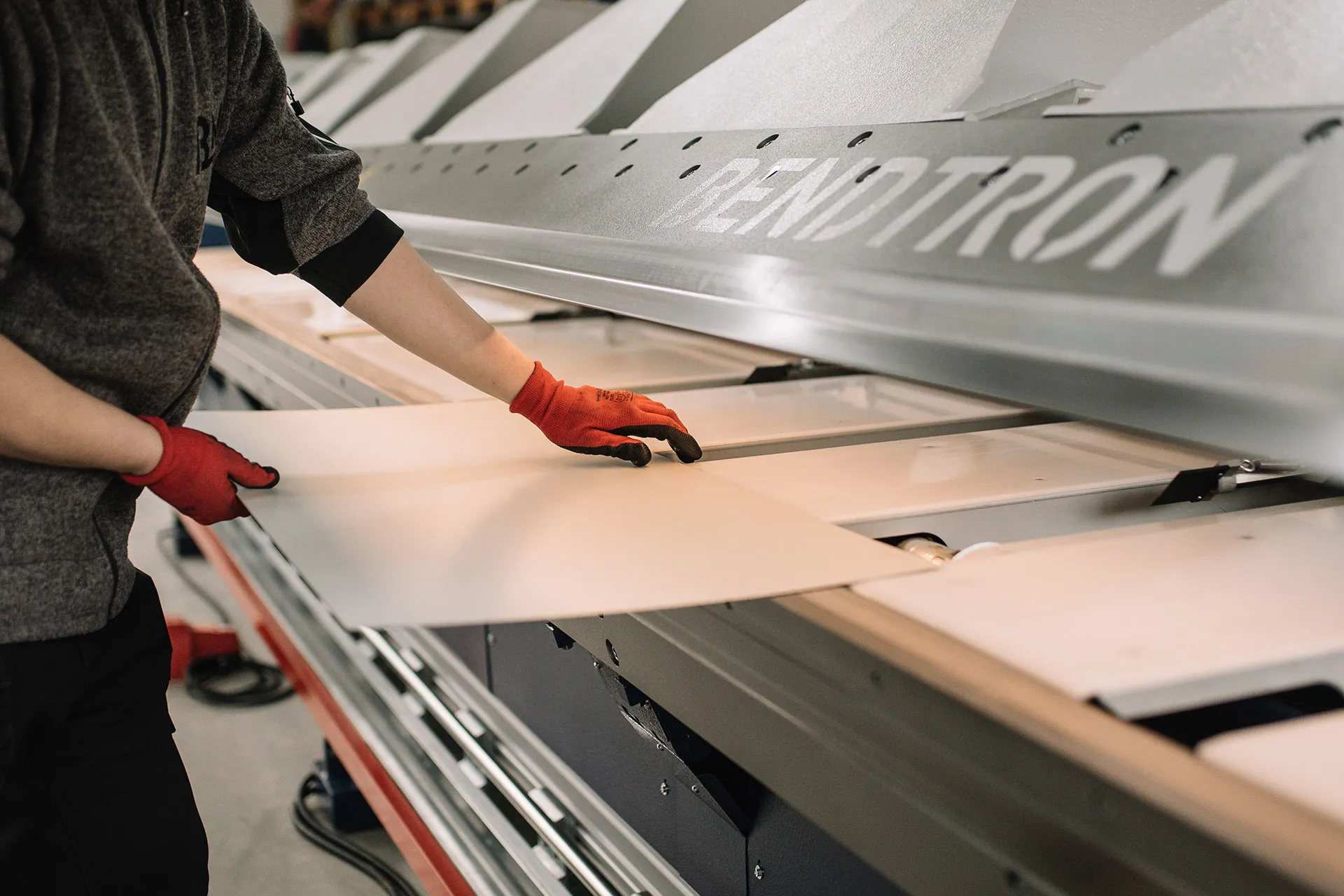
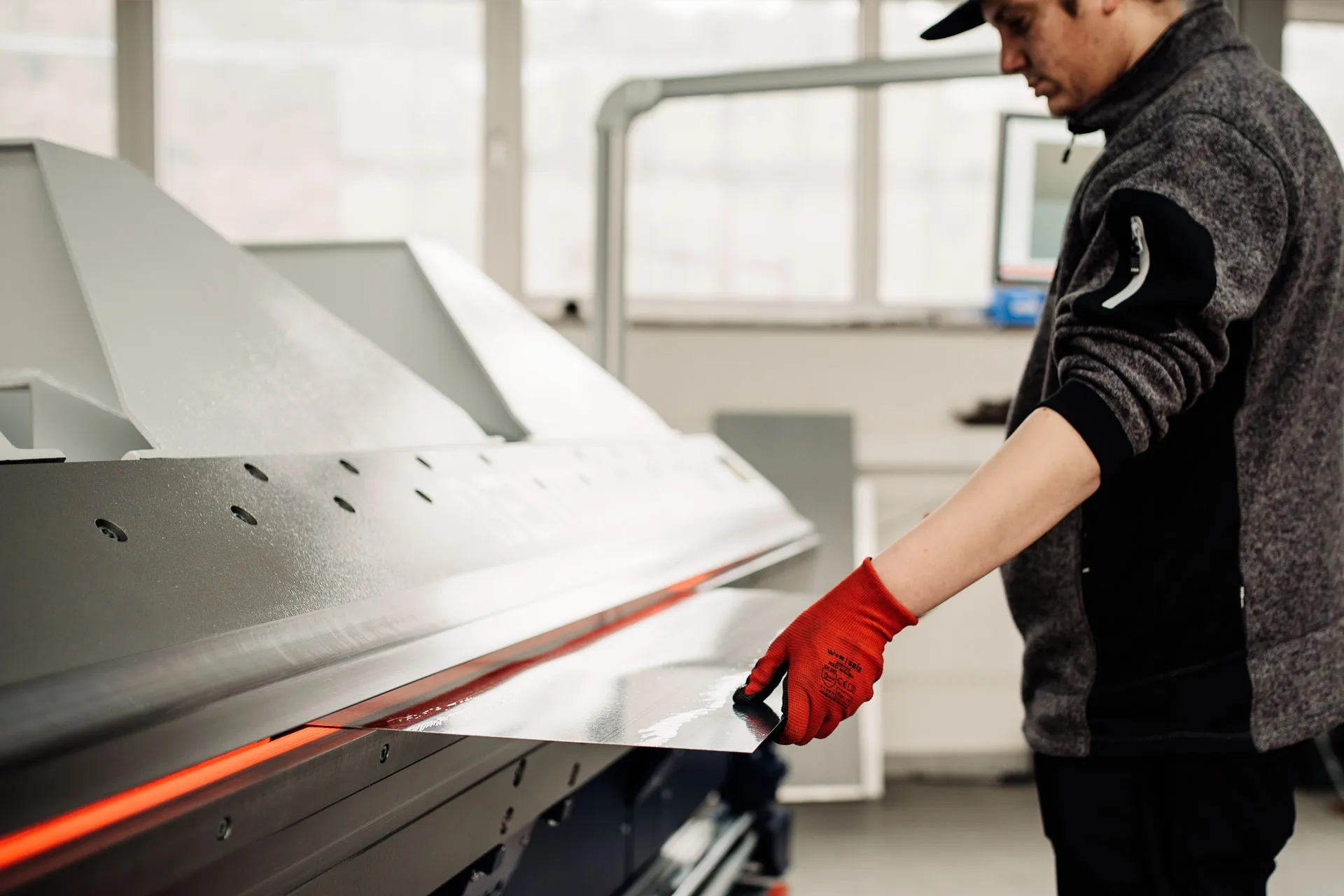
CONICAL BACK GAUGE
The conical back gauge enables precise bending of profiles with varying depths and tapered sections. This allows sheet metal parts to be easily assembled on site during installation. An integrated laser line indicates the exact sheet position and supports millimeter-precise positioning of the blanks.
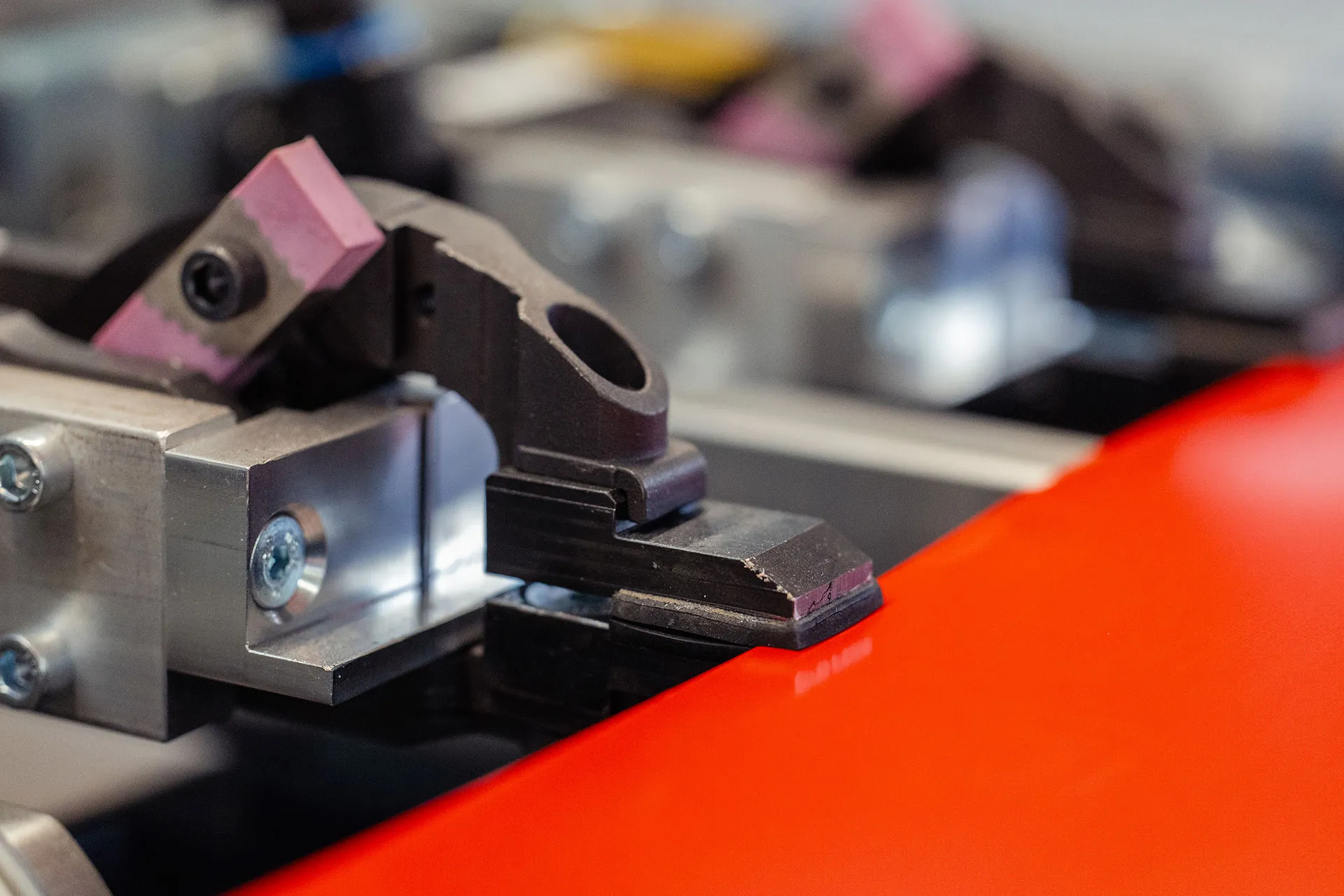
AUTOMATIC GRIPPER SYSTEM
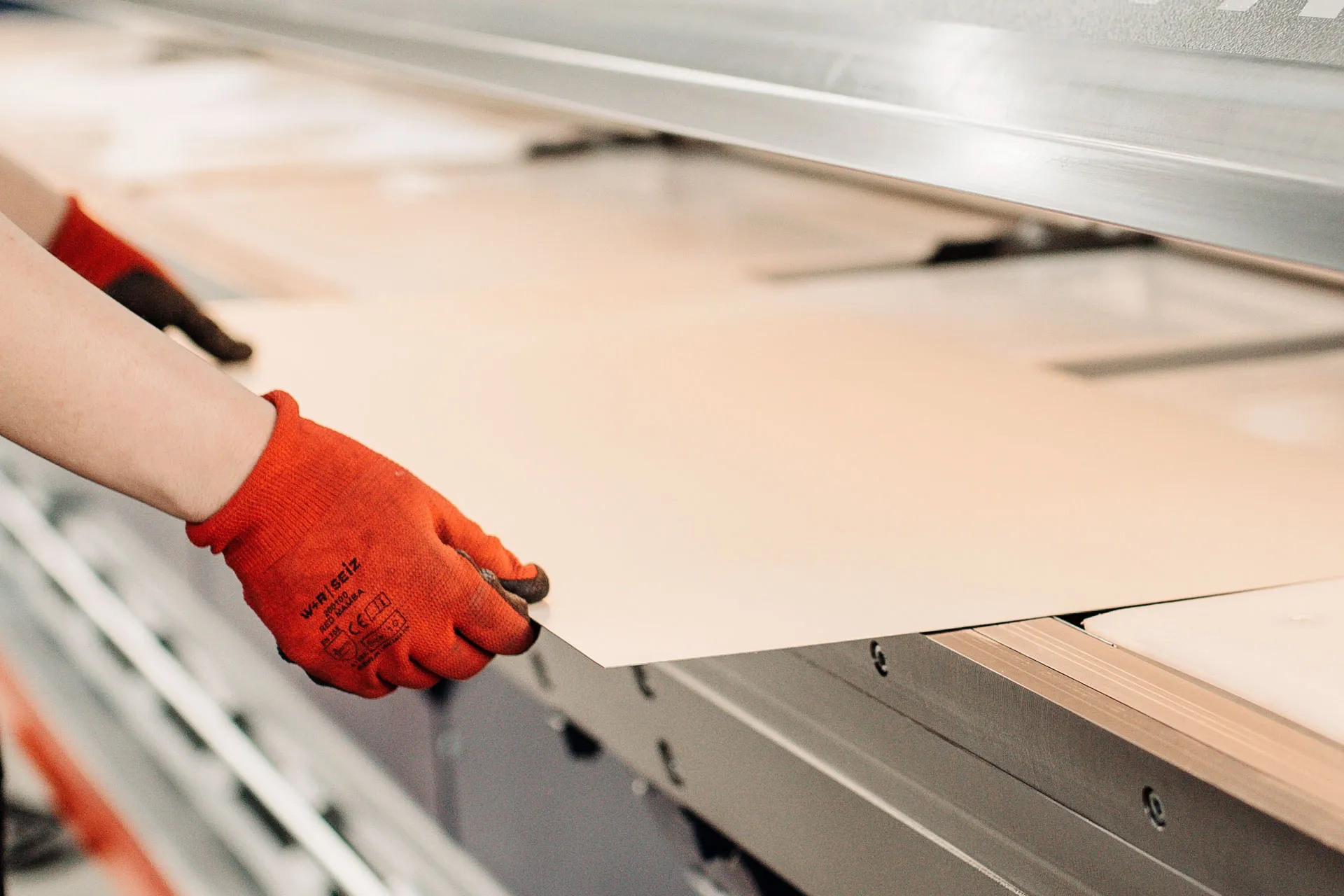
The automatically controlled grippers precisely position and secure the sheet throughout the entire bending process. This reduces manual handling, increases process reliability, and ensures consistently reproducible results. Especially in series production, users benefit from greater efficiency and consistently high quality.
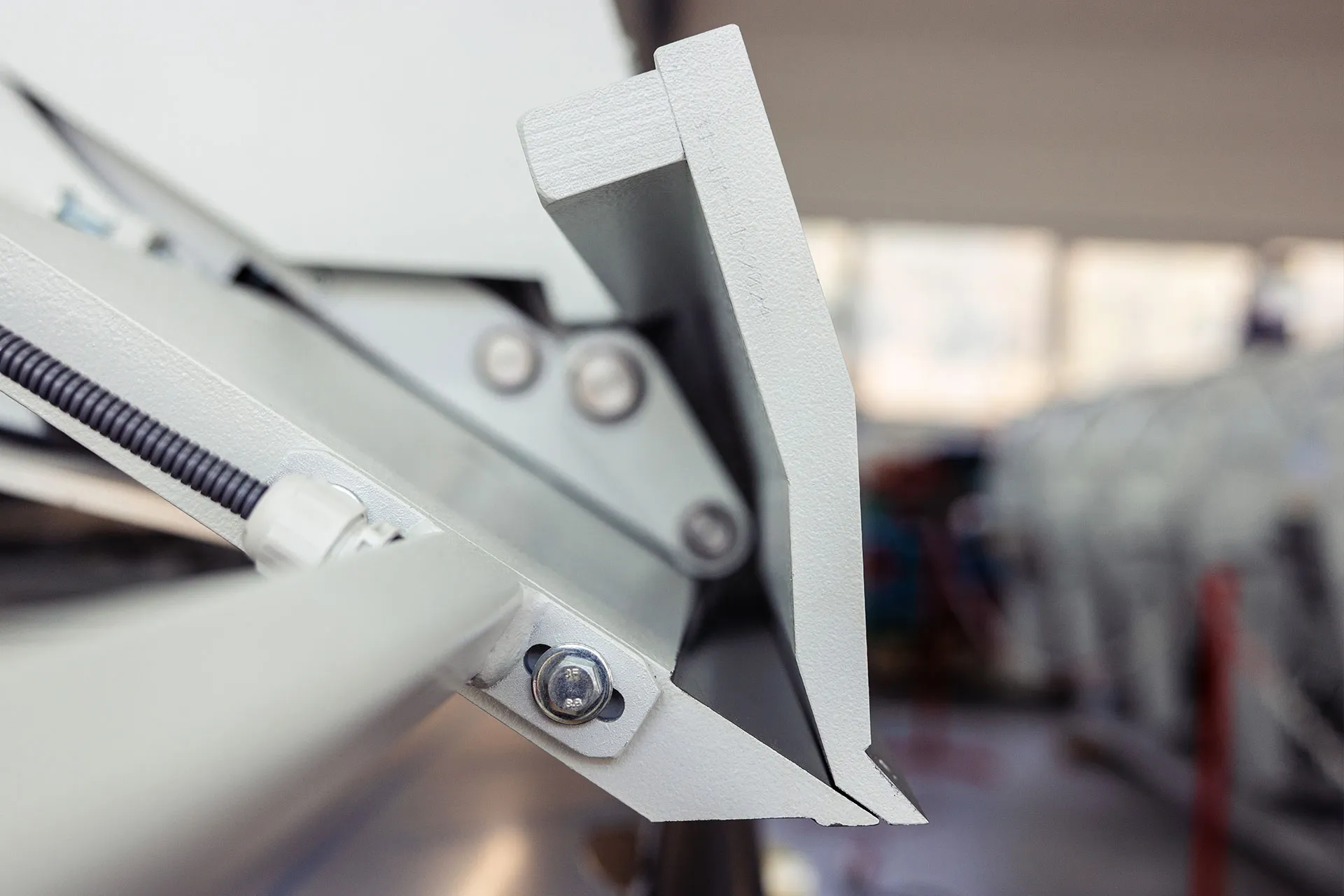
CRANKED BENDING BEAM
The cranked bending beam extends the machine’s working range and provides additional clearance for demanding profile geometries such as hat, trapezoidal, and Z-profiles. This allows complex bends and multi-step profiles to be produced precisely without repositioning the workpiece or requiring additional processing steps. This increases flexibility in profile design and supports efficient production workflows.
AUTOMATIC CLAMPING BEAM ADJUSTMENT
The automatic clamping beam adjustment, or gap adjustment, automatically adapts the gap to different material thicknesses and bending radii. This reduces setup times, simplifies operation, and ensures consistently high bending quality – even when switching between different jobs.
Stable Cutting Unit
The integrated cutting unit enables precise cutting directly during the production process. Once positioned, the sheet is cut to the exact dimension and can then be processed further without any additional steps. Mounted directly to the machine body, the cutting unit operates independently of the bending beam, ensuring consistently high cutting quality. The low-maintenance toothed-belt drive also ensures reliable and durable operation.
Automatische Spannwangenverstellung
Die automatische Spannwangenverstellung bzw. Luftspaltverstellung passt den Luftspalt selbstständig an unterschiedliche Materialstärken und Biegeradien an. Das reduziert Rüstzeiten, vereinfacht die Bedienung und gewährleistet eine gleichbleibend hohe Biegequalität – auch bei wechselnden Aufträgen.
Gekröpfte Biegewange
Die gekröpfte Biegewange erweitert den Arbeitsbereich der Maschine und schafft zusätzlichen Freiraum für anspruchsvolle Profilgeometrien wie Hut-, Trapez- und Z-Profile. Dadurch können auch komplexe Kantungen und mehrstufige Profile präzise gefertigt werden, ohne dass das Werkstück umgespannt oder zusätzliche Bearbeitungsschritte erforderlich werden. Dies erhöht die Flexibilität bei der Profilgestaltung und sorgt für effiziente Fertigungsabläufe.
Stabile Schneideeinrichtung
Die integrierte Schneideeinrichtung ermöglicht einen präzisen Zuschnitt direkt im Fertigungsprozess. Das Blech wird nach dem Positionieren millimetergenau geschnitten und kann anschließend ohne zusätzlichen Arbeitsgang weiterverarbeitet werden. Die am Maschinenkörper montierte Schneideeinrichtung arbeitet unabhängig von der Biegewange und gewährleistet dadurch eine konstant hohe Schnittqualität. Der wartungsarme Antrieb über Zahnriemen sorgt zusätzlich für einen zuverlässigen und langlebigen Betrieb.
BMS Multi-Touch-Steuerung
Die BMS Multi-Touch-Steuerung ermöglicht eine intuitive und komfortable Bedienung direkt über den Touchscreen. Neue Profile lassen sich schnell erstellen oder per Touch-Screen-Painting einfach zeichnen. Gespeicherte Profile können jederzeit aufgerufen und weiterverarbeitet werden. Automatische Biegefolgeberechnungen sowie grafische Simulationen und Vorschauen unterstützen den Anwender bei der effizienten und präzisen Arbeitsvorbereitung.
Einlegetiefe von 1.250 mm
Für lange und großformatige Zuschnitte können Biegemaster-Maschinen mit einer erweiterten Einlegetiefe von bis zu 1.250 mm ausgestattet werden. Das erleichtert die Verarbeitung großer Zuschnitte.
Blechschonende Auflage
Polyethylenauflagen schützen empfindliche, lackierte oder beschichtete Bleche vor Kratzern und Beschädigungen. So lassen sich auch sensible Materialien sicher und schonend verarbeiten.
Automatisches Greifersystem
Die automatisch gesteuerten Greifer positionieren und fixieren das Blech präzise während des gesamten Biegeprozesses. Dies reduziert manuelle Arbeitsschritte, erhöht die Prozesssicherheit und sorgt für konstant reproduzierbare Ergebnisse. Besonders bei Serienfertigung profitieren Anwender von höherer Effizienz und gleichbleibender Qualität.
Automatische Spannwangenverstellung
Die automatische Spannwangenverstellung / Luftspaltverstellung gleicht die Radien bei unterschiedliche Blechstärken selbstständig aus. Dadurch bleibt die Biegegenauigkeit bei dicken Blechen konstant, auch bei wechselnden Materialien und Materialstärken.
Konischer Tiefenanschlag
Der konische Tiefenanschlag ermöglicht das präzise Biegen von Profilen mit unterschiedlichen Tiefen (eng-weit), sowie konische Kantteile. So können die Bleche bei der Montage auf der Baustelle einfach zusammen gesteckt werden. Eine integrierte Laserlinie zeigt die exakte Position des Blechs an und unterstützt das millimetergenaue Anlegen der Zuschnitte.
Automatische Beladetische
Beim Öffnen der Maschine fahren die Beladetische aus der Maschine. Das erleichtert das Einlegen langer Zuschnitte und unterstützt eine ergonomische Arbeitsweise.
A new bending machine is not an investment for just the next job. It should serve your business for many years and fit your team and the work you handle every day.
Before comparing machines and technical specifications, it therefore makes sense to take a closer look at your day-to-day operations.
What types of profiles do we produce most often?
Which materials do we work with?
Do we mainly produce one-off parts or recurring series?
Where does our current bending process take up unnecessary time?
Especially for roofers, sheet metal contractors, and other sheet metal fabrication businesses, the answers can vary considerably. Some produce different custom parts every day, while others regularly manufacture similar profiles in larger quantities.
Choosing the right bending machine therefore starts not with a model name, but with your own bending process.
Flashings, connections, edgings, facade profiles, or custom bent parts: in day-to-day operations, no two jobs are necessarily the same.
For simple profiles with only a few bends, the bending process is usually straightforward. More complex geometries are a different matter. If the sheet has to be repositioned, turned, or flipped several times, additional work steps are required. For a single part, this may hardly matter. When the same operations have to be repeated day after day, however, the situation changes.
A good starting point when choosing a machine is therefore to look at some typical applications and profiles from your day-to-day work.
CHECK 1: DAY-TO-DAY OPERATIONS
Which profiles do we produce most frequently?
How many bends do our typical parts require?
How often does a sheet need to be repositioned during bending?
Do geometries and dimensions change constantly, or do we produce recurring profiles?
Which work steps currently take up the most time?
These questions often provide an initial indication of whether a flexible long folding machine is the priority or whether a more highly automated bending process could be the better approach.
WHAT DOES THE MACHINE NEED TO HANDLE TODAY – AND IN THE FUTURE?
Material, material thickness, and bending length define the technical requirements. A business that primarily works with typical thin sheet metal for roofing and facades has different needs than one that regularly processes thicker materials or particularly long workpieces. It is therefore worth looking beyond your current day-to-day requirements.
Perhaps some jobs are currently outsourced. Certain bent parts may not be produced in-house because the existing machine has reached its limits. Or you may be planning to expand your capabilities over the next few years.
The most powerful machine is therefore not necessarily the right one. What matters is choosing a machine that reliably meets your actual requirements while providing additional capacity where you need it.
CHECK 2: TECHNICAL REQUIREMENTS
Materials processed regularly
Typical and maximum material thicknesses
Required bending lengths
Current limitations of existing equipment
Possible future requirements
This turns the purchase of a new machine into a sound investment that can grow with your business.
ONE-OFF PARTS OR THE SAME PROFILE AGAIN AND AGAIN?
For many sheet metal shops, batch size one is part of everyday business: measure, prepare the profile, bend it – and the next job may look completely different. In this environment, flexibility and the ability to switch easily between different tasks and profiles are key.
In other businesses, profiles or individual work steps are repeated regularly. Here, even a small time saving per workpiece can make a noticeable difference across an entire job. And of course, both scenarios often occur side by side: custom parts for a job in the morning, followed by a larger batch of identical facade profiles.
WHICH WORK STEPS DO WE REPEAT AGAIN AND AGAIN?
This is often where it becomes clear whether different machine equipment or a higher degree of automation can make a real difference.
WHERE AUTOMATION PAYS OFF
Automation is not an end in itself. If nearly every workpiece is different, a highly automated solution does not automatically offer the greatest benefit. With complex or regularly recurring profiles, however, automation can reduce many small work steps that add up over the course of a working day. And it is not just about speed.
How often does the operator have to turn or reposition a long sheet?
How often do dimensions have to be entered again?
How much effort does it take to set up a familiar profile again?
How much experience does an operator need to produce complex bent parts reliably?
These are often more important questions in day-to-day operations than a long list of technical features.
Automation pays off where it takes over repetitive work steps and makes the bending process easier.
What matters, therefore, is not simply how many features a machine offers, but which recurring work steps it actually simplifies in your operation.
WHICH BENDING MACHINE MATCHES MY REQUIREMENTS?
Flexible long folding machine or fully automatic double bender? Hydraulic or electric?
A conventional long folding machine provides the flexibility to process long sheets and a wide variety of profiles. For many typical bending applications, this machine concept is an excellent solution. A double bender, on the other hand, changes the workflow, particularly for profiles with alternating bending directions.
Biegemaster offers four machine concepts for a wide range of requirements in professional sheet metal fabrication.
Fully automatic double bender.
Powerful, precise, and fully automatic bending in both directions – no turning or flipping required.
Anyone looking to improve their bending process should consider the entire workflow:
How is a profile prepared?
How are dimensions transferred to the machine?
How is the sheet positioned?
Which tasks are handled by the operator?
What happens after bending?
Controls, back gauges, gripper systems, cutting devices, and other options can have a significant impact on the actual workflow. Digital work preparation starts even before the first bend is made.
It is therefore worth looking at a typical job from start to finish:
01
PROFILE
Geometry & bends
Profile shapes, bends, and complex geometries determine the requirements for the machine.
02
MATERIAL
Sheet metal & material thickness
Material type, sheet thickness, and required bending lengths define the technical requirements.
03
BATCH SIZE
One-off part or series
Changing one-off jobs and recurring profiles place different demands on the workflow.
04
WORK PREPARATION
Profile & bending sequence
Digital profile creation and a well-planned bending sequence simplify preparation and machine integration.
05
BENDING
The machine process
Machine concept, automation, and equipment determine the individual work steps.
06
BENT PART
The finished workpiece
Precision, repeatability, and minimal rework are key to the final result.
PERSONAL ADVICE FROM BENDING EXPERTS
Every business has different requirements for its bending machine. Together, we determine which machine concept and equipment best match your applications.
We use cookies and similar technologies to provide our website and – with your consent – to analyze the use of our website. You can change or withdraw your choice at any time via the cookie settings.
Functional
Always active
Die technische Speicherung oder der Zugang ist unbedingt erforderlich für den rechtmäßigen Zweck, die Nutzung eines bestimmten Dienstes zu ermöglichen, der vom Teilnehmer oder Nutzer ausdrücklich gewünscht wird, oder für den alleinigen Zweck, die Übertragung einer Nachricht über ein elektronisches Kommunikationsnetz durchzuführen.
Präferenzen
Die technische Speicherung oder der Zugriff ist für den rechtmäßigen Zweck der Speicherung von Präferenzen erforderlich, die nicht vom Abonnenten oder Benutzer angefordert wurden.
Statistics
Die technische Speicherung oder der Zugriff, der ausschließlich zu statistischen Zwecken erfolgt.Die technische Speicherung oder der Zugriff, der ausschließlich zu anonymen statistischen Zwecken verwendet wird. Ohne eine Vorladung, die freiwillige Zustimmung deines Internetdienstanbieters oder zusätzliche Aufzeichnungen von Dritten können die zu diesem Zweck gespeicherten oder abgerufenen Informationen allein in der Regel nicht dazu verwendet werden, dich zu identifizieren.
Marketing
Die technische Speicherung oder der Zugriff ist erforderlich, um Nutzerprofile zu erstellen, um Werbung zu versenden oder um den Nutzer auf einer Website oder über mehrere Websites hinweg zu ähnlichen Marketingzwecken zu verfolgen.